
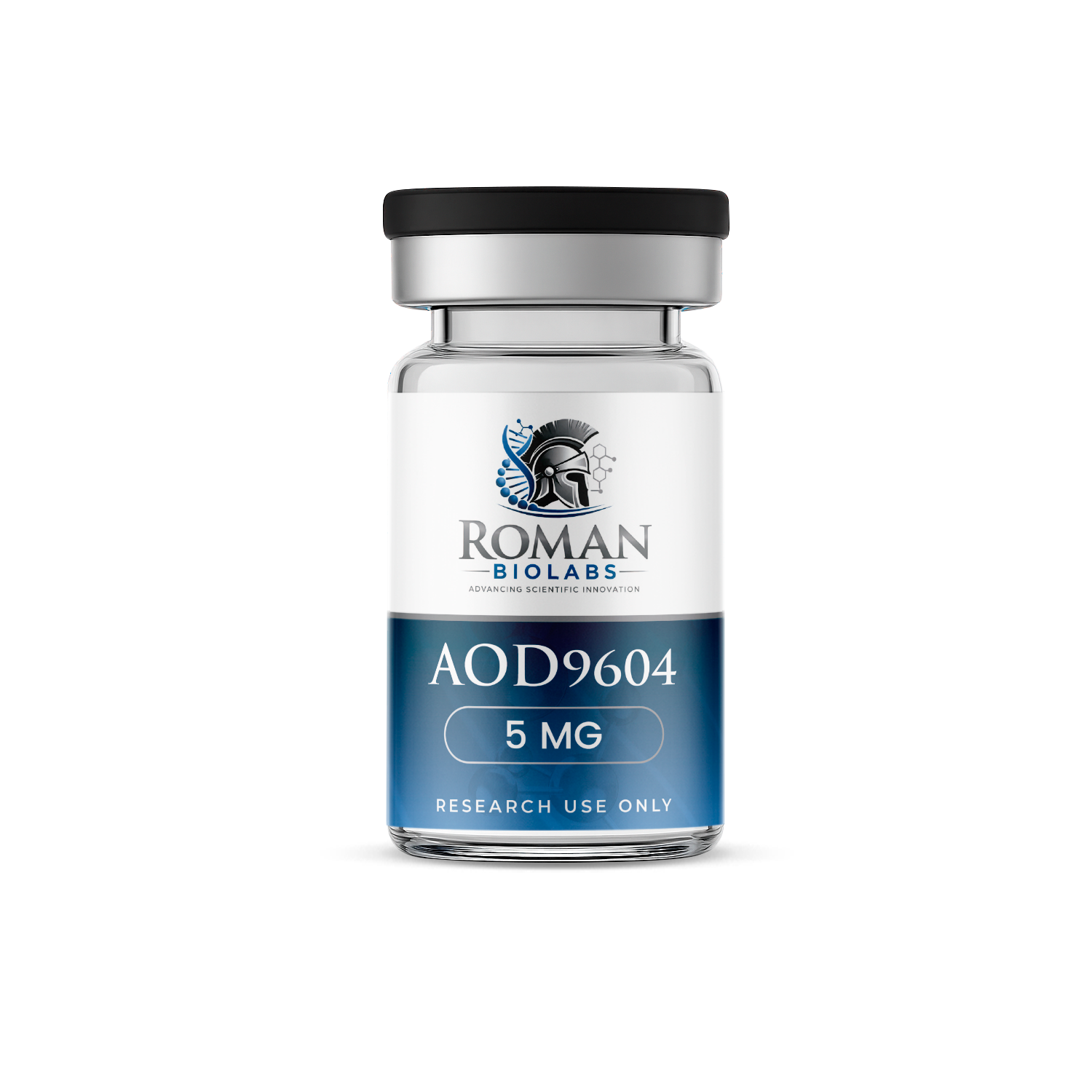
AOD 9604 (5mg)
Original price was: $100.00.$59.95Current price is: $59.95.
Research Utility
- Lipid metabolism and adipocyte signaling studies
- Comparative growth hormone fragment research
- Beta-3 adrenergic receptor interaction assays
- Lipolysis pathway characterization in cell and animal models
In stock
Description
AOD 9604 is a synthetic peptide analogue of the C-terminal fragment of human growth hormone (hGH), specifically the amino acid sequence 177–191. Developed as a modified form of hGH, AOD 9604 retains the lipolytic (fat-metabolizing) domain of the parent molecule while removing the growth-promoting IGF-1-stimulating region. Its molecular weight is approximately 1,815.1 Da, with the sequence Tyr-Leu-Arg-Ile-Val-Gln-Cys-Arg-Ser-Val-Glu-Gly-Ser-Cys-Gly-Phe (disulfide bridged). Research Context AOD 9604 has been studied in preclinical models examining lipid metabolism, adipogenesis inhibition, and lipolytic signaling pathways. Published research has investigated its interactions with beta-adrenergic receptors and its behavior in adipocyte cell culture models. It is commonly selected in studies comparing truncated growth hormone fragments against full-length hGH to isolate specific signaling domains without systemic growth effects.Documentation & Quality Assurance
Each lot is sourced through our verified global supply chain with emphasis on traceability and quality control.These documents are reviewed internally and displayed as they become available. Independent third-party testing is also performed on select lots to confirm identity, purity, and alignment with our internal specifications.
Important Notice
This product is intended for laboratory research use only. It is not intended for human or veterinary use, and must not be used for diagnostic, therapeutic, or clinical purposes.
This material is not a drug, medical device, or dietary supplement, and has not been evaluated by the U.S. Food and Drug Administration.
Quality & Manufacturing
All materials are sourced from carefully vetted domestic and international manufacturing partners who follow quality systems consistent with ISO and cGMP principles. Each supplier is reviewed for reliability, documentation integrity, and transparency in testing.
We require a verified purity of 99% or higher and perform independent third-party spot testing to confirm that select lots meet our internal standards for identity, purity, and composition. Where available, endotoxin testing results are included on Certificates of Analysis to verify laboratory purity; their inclusion is for research quality assessment only and does not imply suitability for human or veterinary use.
All research materials are sealed for integrity and packaged for stability during storage and transport from manufacturing through final delivery.
Additional information
| Weight | 0.0625 lbs |
|---|
Certificate of Analysis
Every batch undergoes independent third-party laboratory analysis to verify identity, potency, and safety. Testing includes quantitative assay verification, heavy metals screening, and comprehensive microbial analysis.
View Certificate of AnalysisStorage Instructions
All products from Roman BioLabs are manufactured using a lyophilization (freeze-drying) process. This method is designed to maintain product integrity and allows vials to remain stable during shipping for approximately 3–4 months.
Once a vial is reconstituted with bacteriostatic water, it should be stored in the refrigerator to help maintain stability. Under these conditions, reconstituted material is generally considered stable for up to 30 days.
Lyophilization is a dehydration technique in which compounds are frozen and then exposed to low pressure. This causes the water in the vial to sublimate directly from solid to gas, leaving behind a stable, crystalline white structure. This powder can be kept at room temperature until reconstitution.
Upon receipt, products should be stored away from heat and light. For short-term use, refrigeration at approximately 4°C (39°F) is suitable. For long-term storage (several months to years), vials may be placed in a freezer at approximately -80°C (-112°F). Freezing is the preferred method for preserving product stability over extended periods.
⚠️ Important Notice:
These products are intended for research use only. Not for human consumption.
Related products
-
Sale!
-
Sale!
-
Sale!
SS-31
Price range: $69.95 through $199.95Select options This product has multiple variants. The options may be chosen on the product page