CJC-1295 Research Guide: DAC vs. No DAC, Half-Life Extension, and Somatotropic Axis Studies
CJC-1295 is a synthetic analogue of growth hormone-releasing hormone (GHRH) and one of the most widely studied long-acting GHRH peptides in preclinical research. It exists in two distinct forms, with DAC (Drug Affinity Complex) and without DAC, each with meaningfully different pharmacokinetic profiles and distinct research use cases. Understanding the difference between the two is fundamental to designing experiments involving the somatotropic axis.
This article provides a scientific reference overview of both CJC-1295 variants, their mechanisms, and their roles in current peptide research. These compounds are supplied for research use only and are not intended for human or veterinary use.
What Is CJC-1295?
CJC-1295 is a modified analogue of the first 29 amino acids of endogenous GHRH (growth hormone-releasing hormone), incorporating four strategic amino acid substitutions that improve enzymatic stability and receptor binding affinity compared to native GHRH. Endogenous GHRH has a half-life of only a few minutes in plasma due to rapid cleavage by dipeptidyl peptidase IV (DPP-IV) and other proteases, CJC-1295's substitutions directly address this by replacing the vulnerable amino acid residues.
The base CJC-1295 sequence (without DAC) is also referred to in literature as Mod GRF 1-29 or Modified GRF(1-29), and this designation is used interchangeably in published research.
CJC-1295 With DAC vs. Without DAC: Key Differences
The primary distinction between the two variants is the presence or absence of a Drug Affinity Complex (DAC), a lysine-maleimidoproprionic acid conjugate that enables the peptide to covalently bind to the cysteine-34 residue on endogenous circulating albumin.
| Feature | CJC-1295 With DAC | CJC-1295 Without DAC (Mod GRF 1-29) |
|---|---|---|
| Half-life (preclinical) | ~6–8 days | ~30 minutes |
| Albumin binding | Yes (covalent) | No |
| GH release pattern | Sustained, blunted pulsatility | Pulsatile, time-limited |
| Molecular weight | ~3,647.3 Da | ~3,367.9 Da |
| Primary research use | Sustained GHRH exposure models | Pulsatile GH secretion studies |
The Albumin-Binding Mechanism (DAC Variant)
When CJC-1295 With DAC is introduced into a plasma-containing system, the maleimide group of the DAC moiety reacts with the free thiol group on albumin's Cys-34 position, forming a stable covalent bond. Since albumin has a half-life of approximately 19 days in humans (similar in rodent models), this binding dramatically extends the circulating half-life of the peptide, from the minutes seen with native GHRH to approximately 6–8 days in preclinical pharmacokinetic studies.
This mechanism makes CJC-1295 With DAC particularly useful in research designs that require:
- Sustained, continuous GHRH receptor stimulation over days rather than hours
- Reduced dosing frequency in longitudinal animal studies
- Comparative pharmacokinetics against shorter-acting GHRH analogues
CJC-1295 Without DAC (Mod GRF 1-29) in Pulsatile GH Research
Without the albumin-binding DAC modification, Mod GRF 1-29 retains a short-duration activity profile that more closely mimics the pulsatile nature of endogenous GHRH release. This makes it the preferred variant in research where timed, discrete GH pulses are the experimental variable of interest.
In somatotropic axis research, Mod GRF 1-29 is commonly paired with GHRP compounds, most frequently Ipamorelin, to study synergistic GH secretion. The GHRH + GHRP combination acts on complementary receptors (GHRH-R and GHSR respectively) to produce GH release patterns that exceed either compound alone, a well-documented synergy in the preclinical literature.
Research Applications
CJC-1295 With DAC:
- Long-acting GHRH pharmacology and receptor saturation studies
- Sustained GH/IGF-1 axis modulation in rodent models
- Albumin-binding peptide half-life extension modeling
- Pharmacokinetic comparison against short-acting GHRH analogues
CJC-1295 Without DAC (Mod GRF 1-29):
- Pulsatile GH secretion and somatotropic axis timing studies
- GHRH + GHRP combination synergy assays (e.g. with Ipamorelin)
- Dose-response kinetics in time-limited GH release models
- GHRH receptor binding and activation assays
Roman BioLabs CJC-1295 Products
Roman BioLabs supplies both CJC-1295 variants as research-grade lyophilized powders, independently tested to ≥98% purity with full third-party COAs available per batch.
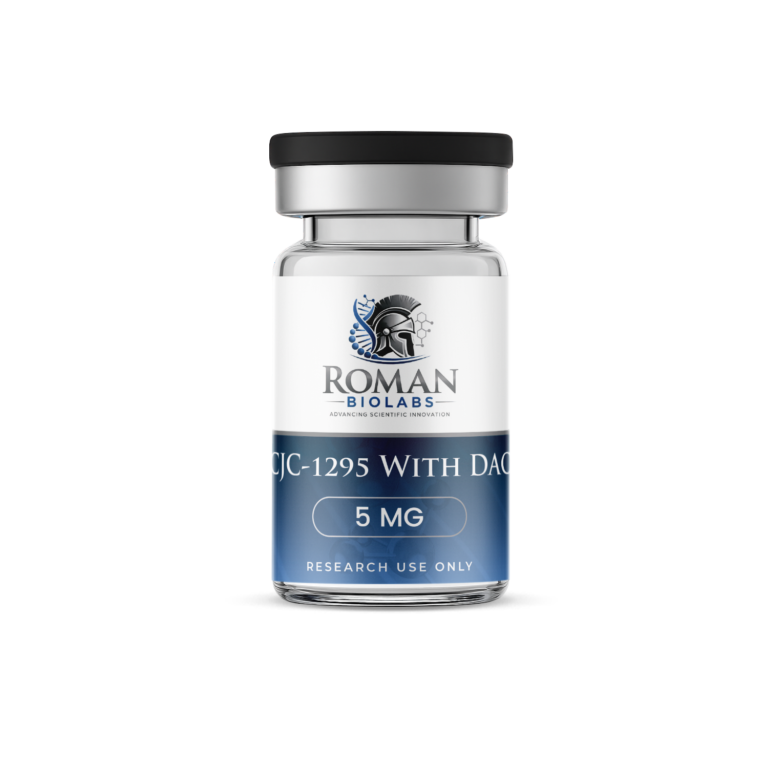
- CJC-1295 With DAC (5mg) →
- Research Use Disclaimer
CJC-1295 (both variants) is intended for laboratory research use only. It is not intended for human or veterinary use and has not been evaluated by the FDA for therapeutic, diagnostic, or clinical purposes. All statements in this article reflect preclinical research findings only.