Published by Roman BioLabs | Research Use Only
Research Use Only Disclaimer: CJC-1295 (both variants) is intended for in vitro laboratory research and preclinical investigation only. It is not approved for human or veterinary use, and has not been evaluated by the FDA for any therapeutic, diagnostic, or clinical purpose. All content in this article reflects preclinical research findings only.
CJC-1295 comes in two chemically distinct forms. The difference is a single molecular modification, but that modification changes almost everything about how the compound behaves in a research system.
If you're designing a study involving the somatotropic axis, selecting the wrong variant won't just affect dosing logistics. It will fundamentally change your GH secretion pattern, your IGF-1 data, and your ability to draw meaningful conclusions from the results.
This article breaks down the mechanistic, pharmacokinetic, and experimental design differences between CJC-1295 with DAC (Drug Affinity Complex) and CJC-1295 without DAC, also known as Modified GRF(1-29) or Mod GRF 1-29, with reference to the published preclinical literature.
What Both Variants Share
Before examining the differences, it's worth establishing the common ground.
Both CJC-1295 variants are synthetic analogues of the first 29 amino acids of endogenous growth hormone-releasing hormone (GHRH). Both incorporate four strategic amino acid substitutions at positions 2, 8, 15, and 27 relative to native GHRH(1-29). These substitutions were designed to resist enzymatic cleavage, specifically by dipeptidyl peptidase IV (DPP-IV), the primary protease responsible for the extremely short (~2 minute) plasma half-life of native GHRH in vivo.
The result, in both variants, is a peptide with significantly improved metabolic stability and enhanced affinity for the GHRH receptor (GHRH-R) on anterior pituitary somatotrophs.
Both variants:
- Bind the GHRH receptor and stimulate GH secretion
- Are supplied in lyophilized powder form for research use
- Require reconstitution before use in experimental systems
- Fall under Research Use Only classification
The divergence begins with what happens, or doesn't happen, after that shared receptor interaction.
The DAC Modification: What It Is and How It Works
The Drug Affinity Complex (DAC) is a lysine-maleimidopropionic acid conjugate attached to the peptide chain in the with-DAC variant. This isn't a passive modification, it's a chemically reactive group designed with a specific purpose: to covalently bond to circulating serum albumin.
When CJC-1295 with DAC enters a plasma-containing biological system, the maleimide group reacts with the free thiol (–SH) group on cysteine-34 of endogenous albumin. The resulting bond is stable and essentially irreversible under physiological conditions.
This is significant because albumin is one of the most long-lived proteins in circulation, with a plasma half-life of approximately 19 days in humans (similar dynamics are observed in rodent models, though shorter in absolute terms). By hitching to albumin, CJC-1295 with DAC effectively inherits albumin's pharmacokinetic stability.
The practical outcome: a peptide that would otherwise be cleared in under an hour now persists in the system for days.
Pharmacokinetic Profiles: The Core Difference
This is where the two variants diverge most sharply, and where experimental design decisions are made.
| Parameter | CJC-1295 With DAC | CJC-1295 Without DAC (Mod GRF 1-29) |
|---|---|---|
| Plasma half-life | ~6–8 days | ~30 minutes |
| Albumin binding | Covalent (via DAC-Cys34) | None |
| GH release pattern | Sustained, tonically elevated | Pulsatile, time-limited |
| IGF-1 elevation duration | Days to weeks | Hours |
| Molecular weight | ~3,647.3 Da | ~3,367.9 Da |
| Research dosing frequency | Low (1–2x weekly in animal studies) | High (multiple administrations per session) |
CJC-1295 With DAC: Sustained GH Elevation
In the landmark 2006 clinical pharmacology study by Teichman et al. (Journal of Clinical Endocrinology & Metabolism, PMID: 16352683), single-dose administration of CJC-1295 with DAC produced mean GH increases of 2- to 10-fold that were sustained for up to 6 days. Mean IGF-1 levels remained above baseline for up to 28 days following multiple doses. The estimated half-life of CJC-1295 was confirmed at 5.8–8.1 days.
Critically, the study observed that while GH was elevated, natural pulsatility was not eliminated, it was superimposed on a higher tonic baseline. This point matters for research design: DAC does not produce a flat, constant GH signal. It raises the floor of GH secretion while preserving some pulsatile architecture.
A follow-up investigation (Ionescu & Frohman, Journal of Clinical Endocrinology & Metabolism, 2006; PMID: 17018654) confirmed that pulsatile GH secretion persisted during sustained GH-releasing hormone agonist administration with CJC-1295, reinforcing that the two systems, pulsatile and tonic, are not mutually exclusive but are altered in their relative contributions.
CJC-1295 Without DAC: Pulsatile GH Stimulation
Without the albumin anchor, Mod GRF 1-29 operates within a much tighter temporal window. Its ~30-minute half-life means that GH stimulation is acute, discrete, and tied closely to the moment of administration.
This pharmacokinetic profile makes Mod GRF 1-29 the preferred tool for studies where the timing and pattern of GH secretion is the variable of interest, not simply whether GH is elevated. Research designs examining GH pulse amplitude, pulse frequency, or the interaction between exogenous GHRH analogues and endogenous pulsatile GH architecture almost uniformly use a short-acting variant.
The Ipamorelin Synergy: Why Mod GRF 1-29 Is Rarely Used Alone
One of the most well-documented findings in preclinical peptide research is the synergistic GH release produced by combining a GHRH analogue with a growth hormone-releasing peptide (GHRP).
CJC-1295 without DAC is most commonly studied in combination with Ipamorelin, a selective GHSR agonist (ghrelin mimetic). The two compounds act on different but complementary receptors:
- Mod GRF 1-29 → binds GHRH receptor (GHRH-R) on pituitary somatotrophs → amplifies GH pulse amplitude
- Ipamorelin → binds the GH secretagogue receptor (GHSR-1a) → increases GH pulse frequency and suppresses somatostatin
The combination produces GH release that exceeds either compound administered alone, a well-established synergy in the preclinical GH secretagogue literature. Because both compounds have short, time-matched half-lives, researchers can design timed pulse experiments with a level of temporal precision that a long-acting compound like CJC-1295 with DAC cannot provide.
This combination paradigm is not typically studied with the DAC variant, where the sustained GH elevation would confound the acute-pulse experimental model.
Experimental Design: Which Variant Fits Which Study?
The decision between CJC-1295 with DAC and without DAC is ultimately a research design question. The relevant factors are:
Use CJC-1295 With DAC when:
- Your study requires chronic, sustained GH/IGF-1 elevation without repeated administration
- You're modeling long-term somatotropic axis stimulation across days or weeks in animal subjects
- You need to reduce administration burden in longitudinal animal studies
- You're studying albumin-binding pharmacokinetics as a drug delivery mechanism
- Your outcome measures are cumulative (e.g., tissue growth, sustained IGF-1 modulation) rather than time-resolved pulse data
Use CJC-1295 Without DAC (Mod GRF 1-29) when:
- Your study examines pulsatile GH secretion architecture or GH pulse timing
- You're running combination studies with GHRPs (e.g., Ipamorelin) to study somatotropic synergy
- You need acute, time-limited GH stimulation with precise on/off control
- You're studying dose-response kinetics across a single administration session
- You're investigating GHRH receptor binding and activation dynamics
- Your experimental design requires physiological plausibility, i.e., mimicking natural GHRH pulsatility rather than tonic elevation
When both might be relevant:
Comparative pharmacokinetic studies that use both variants as reference arms can help quantify the contribution of sustained vs. pulsatile stimulation to downstream outcomes such as IGF-1 production, body composition markers in animal models, or cellular proliferation indices. Roman BioLabs supplies both variants to support exactly these types of parallel experimental designs.
A Note on Nomenclature
The research literature uses several terms interchangeably, which creates confusion. For clarity:
| Name | Refers to |
|---|---|
| CJC-1295 with DAC | The long-acting, albumin-binding variant (~6–8 day half-life) |
| CJC-1295 without DAC | The short-acting variant (~30 min half-life) |
| Mod GRF 1-29 | Same as CJC-1295 without DAC |
| Modified GRF(1-29) | Same as CJC-1295 without DAC |
| DAC-GRF | Same as CJC-1295 with DAC, used in early Ionescu & Frohman literature |
When reviewing published studies, confirm which variant was used before drawing comparisons. The pharmacokinetic differences are large enough that results from DAC studies cannot be generalized to no-DAC studies, and vice versa.
Storage and Handling for Research Use
Both CJC-1295 variants are supplied by Roman BioLabs in lyophilized (freeze-dried) powder form, sealed in sterile vials.
Recommended storage:
- Long-term: −20°C (up to 24 months)
- Short-term: 2–8°C (up to 3 months, away from light and moisture)
- Avoid repeated freeze-thaw cycles, which can degrade peptide integrity
Reconstitution: Use bacteriostatic water or sterile water for injection (research grade). Reconstituted solutions should be stored at 2–8°C and used within the timeframe appropriate to your experimental protocol.Third-party Certificates of Analysis (COAs) are available per batch.
Summary: Key Decision Points
| Research need | Recommended variant |
|---|---|
| Sustained GH/IGF-1 elevation, low dosing frequency | CJC-1295 With DAC |
| Pulsatile GH studies, acute responses | CJC-1295 Without DAC (Mod GRF 1-29) |
| GHRP combination studies (e.g., with Ipamorelin) | CJC-1295 Without DAC |
| Albumin-binding pharmacokinetic modeling | CJC-1295 With DAC |
| Long-duration rodent studies | CJC-1295 With DAC |
| Physiological GH pulse mimicry | CJC-1295 Without DAC |
Roman BioLabs CJC-1295 Products
Roman BioLabs supplies both variants as research-grade lyophilized peptides, tested to ≥98% purity with full third-party COAs:
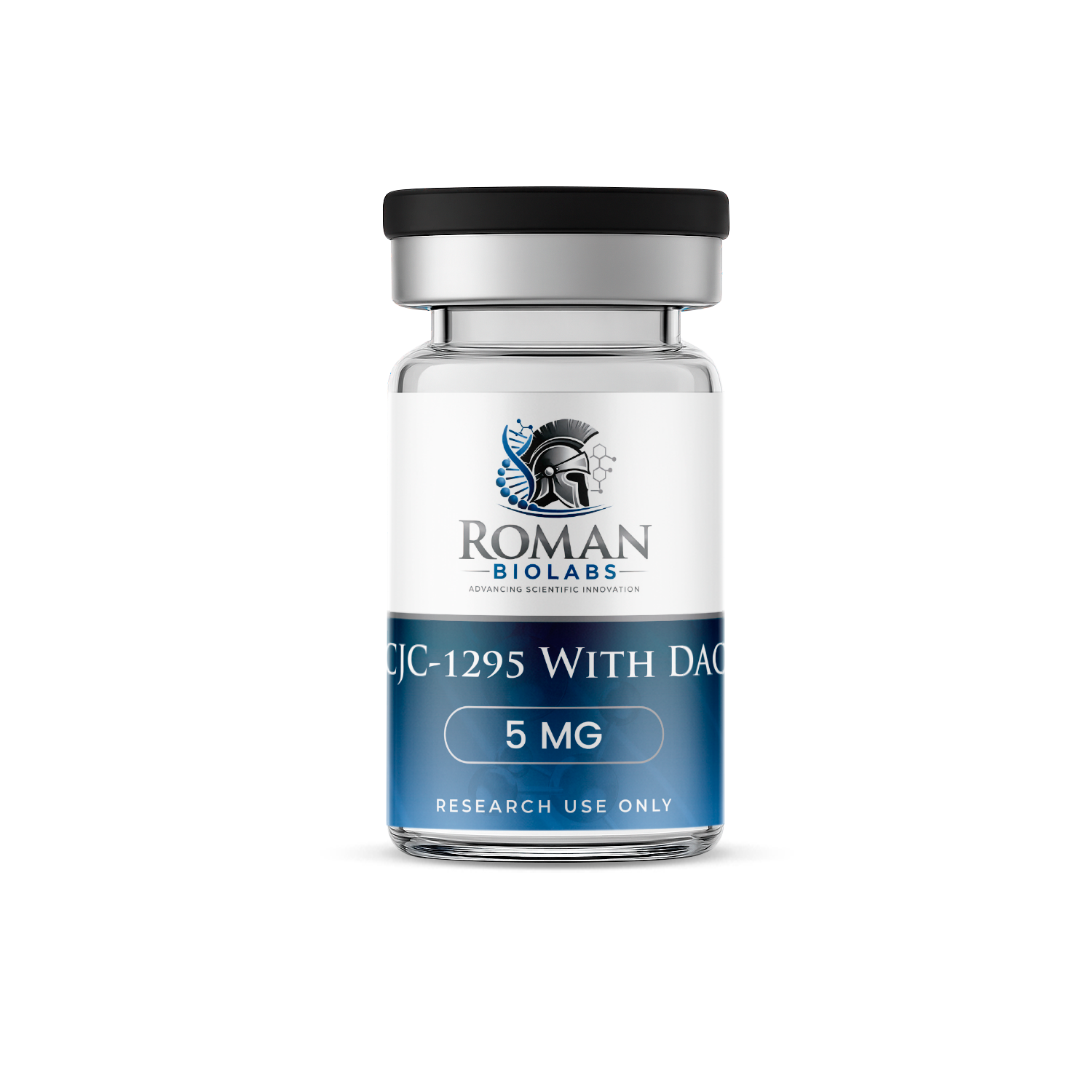
- CJC-1295 With DAC (5mg) → View product
- CJC-1295 Without DAC (10mg) → View product
- 2x Blend CJC-1295 without DAC 5mg/ Ipamorelin 5mg View product
For a broader overview of CJC-1295, including full structural background and somatotropic axis context, see our CJC-1295 Peptide Research Guide.
References
- Teichman, S.L., et al. (2006). Prolonged stimulation of growth hormone (GH) and insulin-like growth factor I secretion by CJC-1295, a long-acting analog of GH-releasing hormone, in healthy adults. Journal of Clinical Endocrinology & Metabolism, 91(3), 799–805. PubMed: 16352683
- Ionescu, M., & Frohman, L.A. (2006). Pulsatile secretion of growth hormone (GH) persists during continuous stimulation by CJC-1295, a long-acting GH-releasing hormone analog. Journal of Clinical Endocrinology & Metabolism, 91(12), 4792–4797. PubMed: 17018654
- Jetté, L., et al. (2005). hGRF1-29-albumin bioconjugates activate the GRF receptor on the anterior pituitary in rats: a potential long-acting GRF analog. Endocrinology, 146(7), 3052–3058. PubMed: 15817669
All products referenced in this article are supplied by Roman BioLabs for in vitro research and preclinical laboratory use only. These compounds are not approved for human or veterinary use and have not been evaluated by the FDA for any therapeutic or clinical purpose. Researchers are responsible for compliance with all applicable laws and institutional guidelines governing peptide research.
Frequently Asked Questions
The core difference is half-life. CJC-1295 with DAC covalently binds to serum albumin via its Drug Affinity Complex moiety, extending its half-life to approximately 6–8 days. CJC-1295 without DAC (Mod GRF 1-29) has no albumin-binding capacity and a half-life of approximately 30 minutes. This produces fundamentally different GH release patterns, sustained and tonic with DAC; pulsatile and time-limited without.
Mod GRF 1-29 (CJC-1295 without DAC) and Ipamorelin act on complementary receptors, GHRH-R and GHSR-1a respectively. When co-administered in preclinical models, they produce synergistic GH release exceeding either compound alone. Their matched short half-lives also allow researchers to design timed GH pulse experiments with precise temporal control.
No. Research by Ionescu & Frohman (2006) demonstrated that pulsatile GH secretion persists during sustained GH-releasing hormone agonist administration. CJC-1295 with DAC raises the tonic GH baseline but does not fully suppress the pulsatile architecture driven by endogenous hypothalamic regulation.
Yes. Comparative pharmacokinetic designs that use both variants as experimental arms are a legitimate approach for quantifying the contribution of sustained vs. pulsatile GHRH stimulation to downstream outcomes.